Introduction
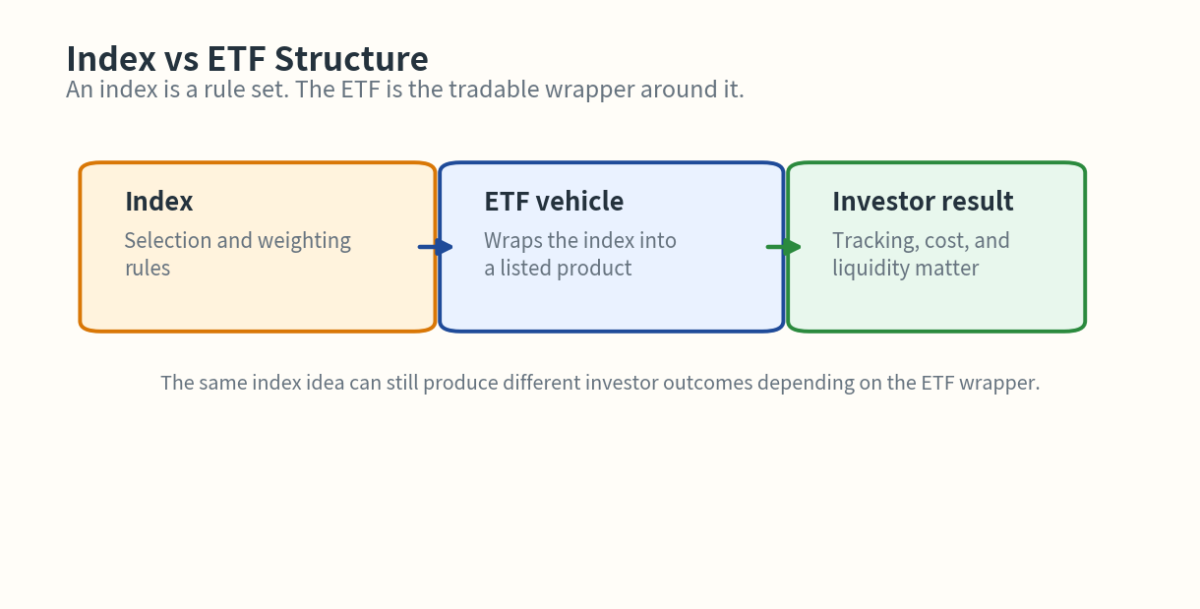
Many beginners treat an index and an ETF as if they were the same thing. They are related, but they are not identical. An index is a calculation rule. An ETF is a product built to track something, often an index.
That difference matters because products can differ even when the underlying index is the same.
One-line summary
An index is a rule-based benchmark. An ETF is a tradable product built to track an exposure.
Core framework
The cleanest split is:
- index: a benchmark or ruleset
- ETF: a vehicle with fees, structure, and execution details
This is why two ETFs can track the same index yet behave differently in cost, liquidity, tracking, and investor experience.
How it connects to investing
Understanding the gap between index and ETF helps investors ask better questions:
- what exactly is the benchmark?
- how does the ETF track it?
- what costs or frictions exist?
Without that distinction, investors often buy the label and ignore the product.
Visual guide
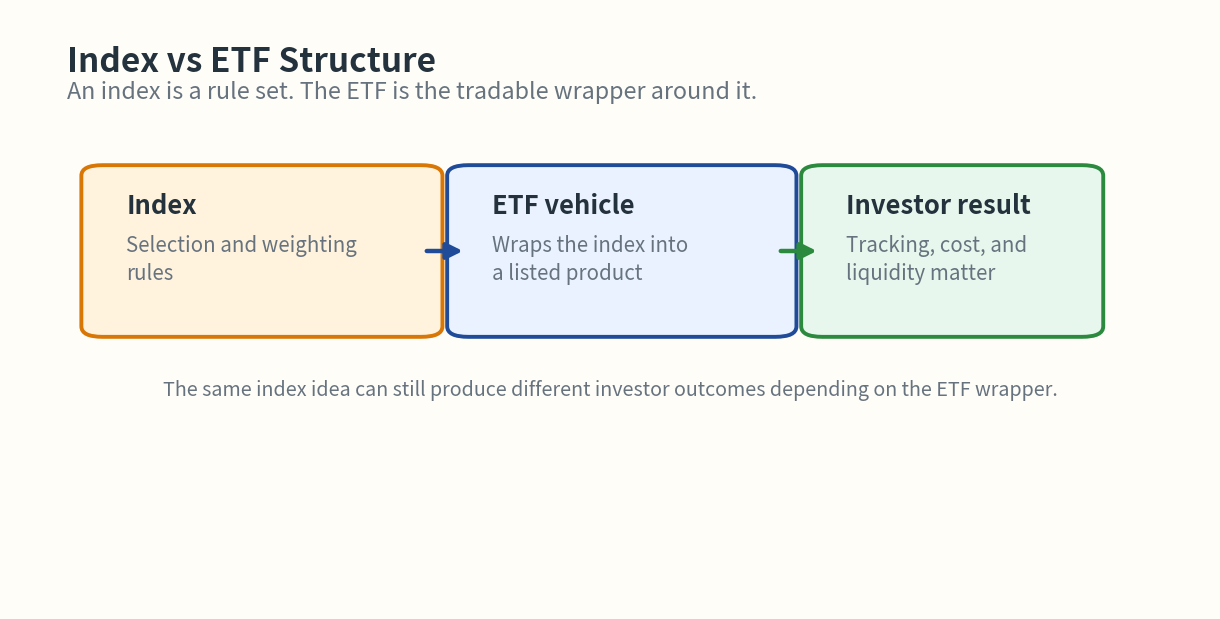
The index defines exposure. The ETF determines how that exposure reaches the investor.
Practical framework
Use this order:
- Identify the benchmark
- Check the ETF’s structure and fees
- Check tracking quality and trading behavior
- Decide whether the ETF is the right product for that benchmark exposure
Investor checklist
- What index or benchmark is the ETF following?
- How does the ETF replicate it?
- What fees and frictions come with the product?
- Is liquidity good enough?
- Does the product behave as expected in practice?
Common mistakes
- Treating the index name as the entire product story
- Ignoring fees and execution
- Assuming all ETFs tracking the same index are interchangeable
- Failing to check how the ETF actually tracks the benchmark
Summary
An index is a benchmark, not an investment product. The ETF is the product. Investors who keep that distinction clear usually make better choices among similar-looking funds.