One-line summary
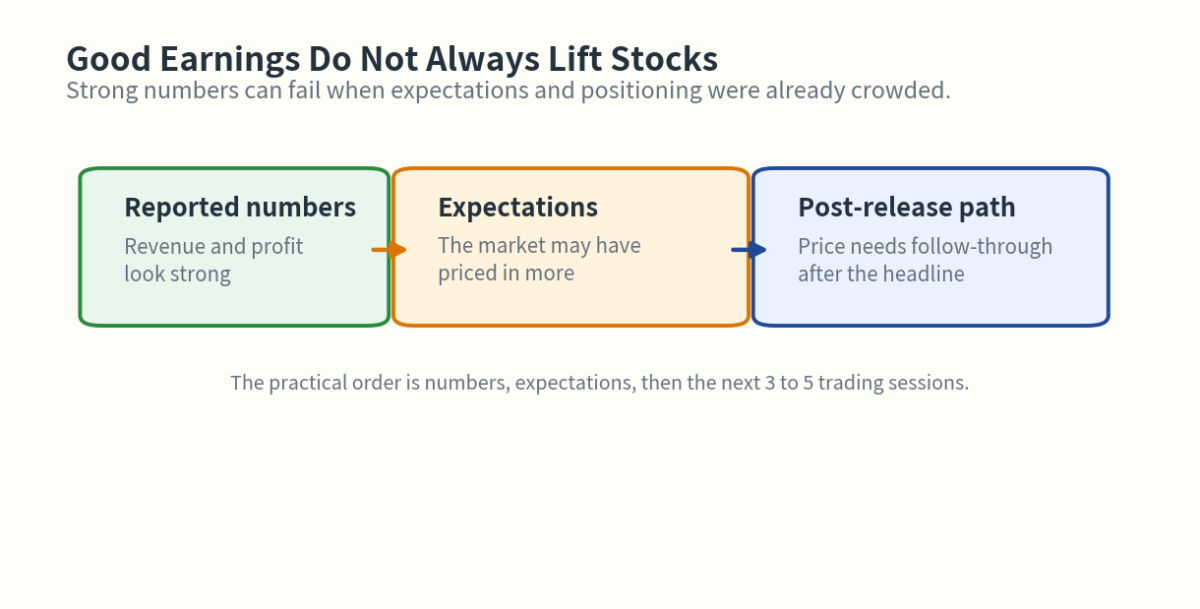
Good numbers do not guarantee a rising stock. Investors need to separate filing facts from expectations, positioning, and price behavior before and after the release.
Why this matters
Many beginners ask the same question after an earnings release: If earnings were good, why did the stock fall?
The answer is usually that the market is not reacting to the number alone. It is reacting to the gap between the number and prior expectations, how much was already priced in, and whether the quality of the improvement matched what mattered most.
That is why good earnings can still lead to weak price action.
Where to look in DART
The most practical order is:
- Confirm the actual numbers in the filing
- Check which line improved most: revenue, operating profit, margin, or net income
- Check where the stock was trading before the release
- Check the close and turnover on the release day
- Check the next three to five trading days for follow-through
The useful sequence is filing facts -> pre-release positioning -> release-day reaction -> short follow-through.
Visual guide
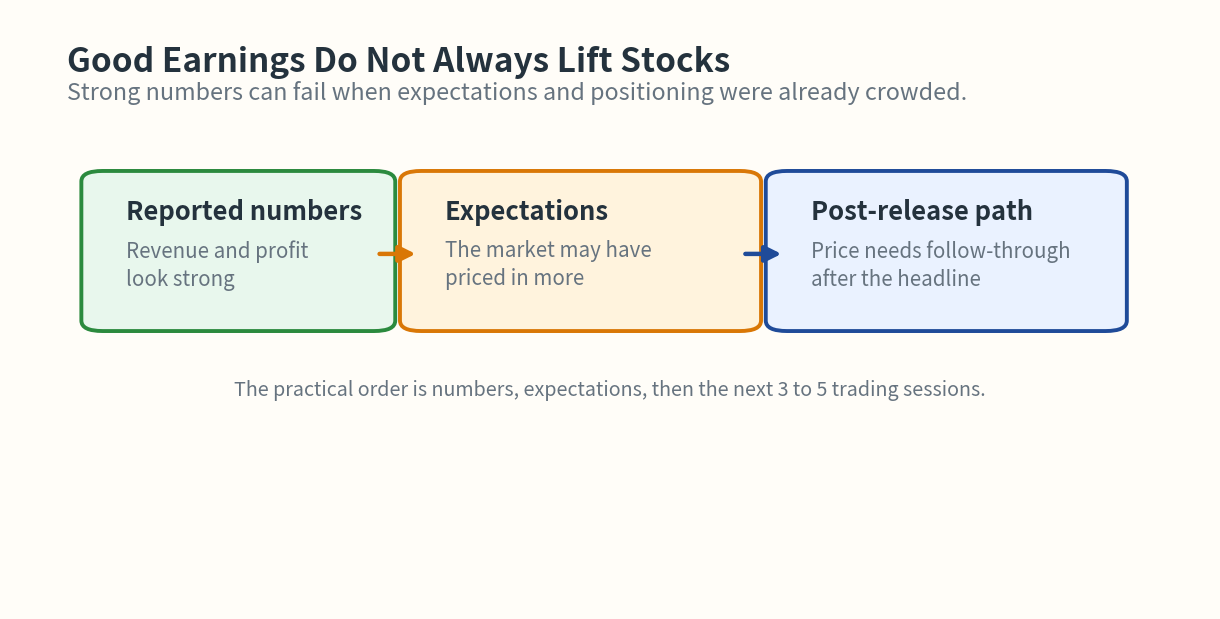
Strong numbers and strong stock reactions are related, but they are not the same thing.
Core concept
There are four common reasons a stock can fall even after good earnings:
- Expectations were already very high
- The wrong line improved
- The market doubted repeatability
- Positioning was crowded before the release
For example, a company may report strong revenue growth, but the market may have cared more about margin. Or the company may post good margin, but investors may think the improvement is temporary.
Practical reading framework
| Step | What to check | Why it matters |
|---|---|---|
| Filing facts | Revenue, operating profit, margin, net income | Shows what actually happened |
| Pre-release position | Prior rally, valuation, expectations | Shows what may already be priced in |
| Release day | Close, turnover, intraday response | Shows the first interpretation |
| Follow-through | Next 3-5 days | Shows whether the market agrees after the first reaction |
This is more useful than trying to explain the stock move with one headline line.
How the market reacts
Markets often react more strongly to surprise quality than to simple good numbers.
- Strong numbers with weak reaction can mean high expectations
- Mixed numbers with a strong reaction can mean low expectations or improving interpretation
- Weak first-day reaction with later stability can still be constructive
That is why investors should read the number and the price in separate layers.
Investor checklist
- Which line actually improved most?
- Was the stock already strong before the release?
- Did the release-day close confirm or reject the first headline?
- Did the next few trading days support the initial move?
- Did the market care more about margin, guidance, or repeatability than about the headline?
Common mistakes
- Assuming good earnings must produce a rising stock
- Ignoring expectations before the release
- Treating release-day volatility as the full answer
- Focusing on revenue when margin mattered more
- Confusing a temporary bounce with real follow-through
Summary
Good earnings and a rising stock are related, but they are not the same event. The useful sequence is filing facts -> pre-release positioning -> release-day reaction -> short follow-through. Investors who separate those layers make fewer shallow conclusions.