Introduction
Capex does not always look important on the income statement right away, which is why many beginners overlook it. But capex is often one of the clearest signals of what management believes about future demand and where the company is placing real capital.
Still, not every capex plan is bullish. Demand visibility, payback path, and financing burden all matter.
Why business structure matters
Capex shows business direction through action rather than language. Management can talk about growth all day, but where it puts factories, equipment, and capital reveals what the real priority is.
That is why capex is not just spending. It is often a statement about the company’s assumptions about the future. The challenge is deciding whether it is a strong investment or a future burden.
Core framework
The first question is what the capex is for. Maintenance spending, expansion spending, product-transition spending, and new-business entry should not be treated the same way.
The second question is how visible demand really is. Long-term contracts, customer expansion, higher utilization, bottleneck removal, and product upgrades make capex more credible. Vague market optimism does not.
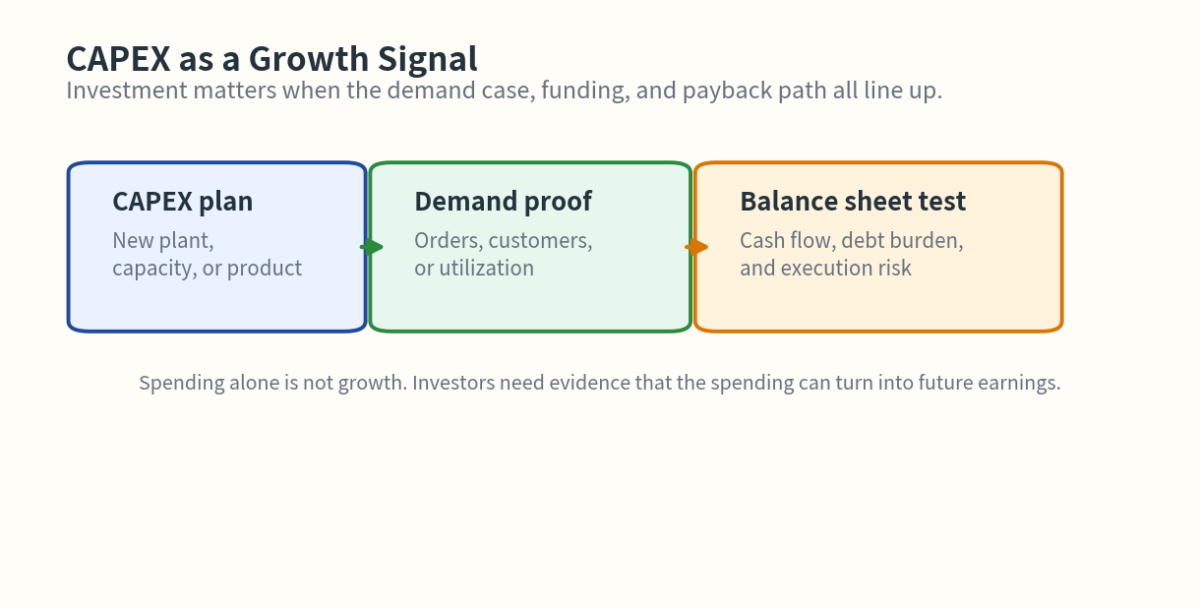
The third question is whether payback and financing are manageable. Capex eventually turns into depreciation, cash outflow, and sometimes financing pressure. If operating cash flow and the balance sheet can carry it, capex can be a strong growth signal. If not, it can become a burden signal instead.
Visual guide
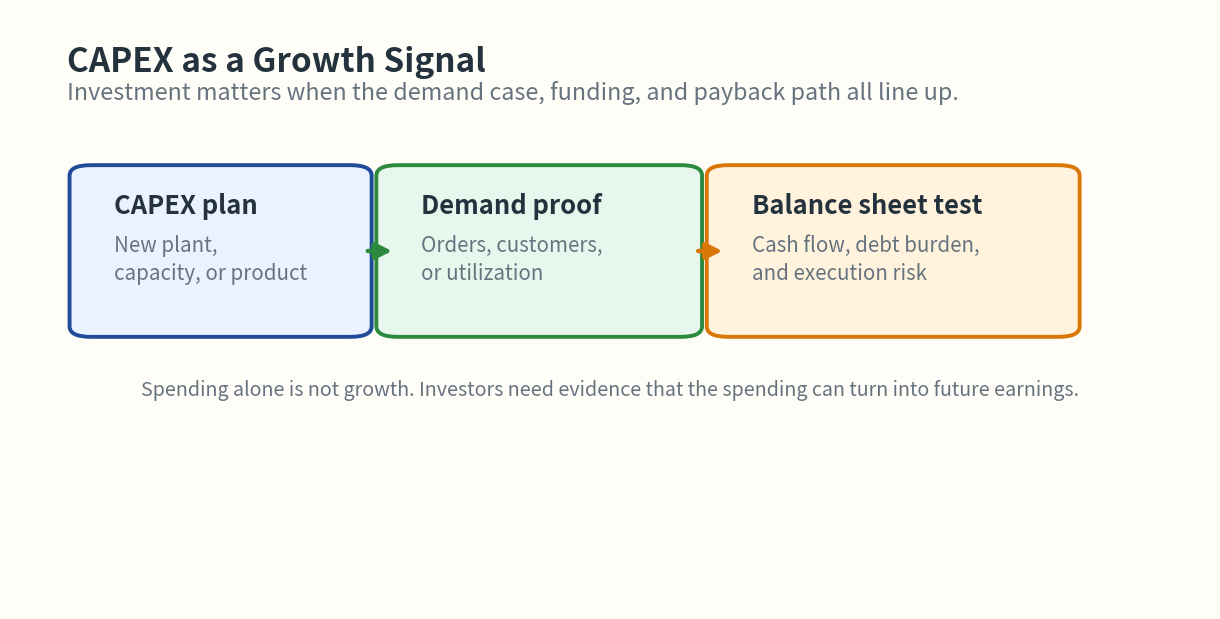
Capex should be read through demand visibility and payback quality before it is read as a simple bullish event.
Where to verify it
Use these sources together:
- Annual report: facilities, R&D, business description, and investment purpose
- Recent disclosures: contracts, investment decisions, financing, expansion plans
- Financials: capex scale, depreciation, operating cash flow, debt change
- Market reaction: expectations before the announcement, announcement-day reaction, and follow-through
The practical sequence is investment purpose -> demand support -> payback timeline -> cash flow and leverage -> market expectations.
What to check in a company
Use this checklist:
- Is the capex for maintenance or growth?
- Is there visible demand support through customers, contracts, or product transition?
- Is the start-up and payback timeline reasonably clear?
- Can operating cash flow and the balance sheet carry the investment?
- Has the market already priced in too much of the story?
Investor checklist
- Did you separate maintenance capex from growth capex?
- Did you confirm demand through contracts, customers, or utilization rather than just management language?
- Did you check payback timing and future depreciation?
- Can cash flow and leverage realistically absorb the project?
- Did you check follow-through instead of treating the announcement as enough by itself?
Typical misunderstandings
- Bigger capex automatically means stronger growth.
- A large expansion budget is enough to validate the story.
- Payback and financing can be ignored if the strategic direction sounds strong.
Example scenario
Imagine a battery-materials company announcing capex expansion alongside long-term supply agreements. That setup deserves a stronger reading because the investment has visible customers, a product path, and a clearer demand case.
Now imagine a company in a weakening cycle announcing a large new build based mostly on broad future optimism. If customer proof is weak, payback is distant, and financing stress is rising, the market may read the same capex as overinvestment instead of growth.
The practical split is:
- Facts: investment purpose, contracts, capex size, depreciation, leverage
- Interpretation: whether the investment is becoming a growth signal or a burden signal
Common mistakes
- Reading capex announcements as proof that long-term growth is already secured
- Focusing on spending size while skipping demand proof and payback timing
- Interpreting capex without connecting it to cash flow and financing
- Treating one day of price reaction as enough evidence
Summary
Capex can be a signal about the future, but only after it passes through demand visibility, payback quality, and financing discipline.
The most useful order is investment purpose -> demand support -> payback timeline -> cash flow and leverage -> market expectations.