One-line summary
QoQ is often better for reading short-term turns, while YoY is often better for judging whether the business is improving against a cleaner base. Good earnings reading usually needs both.
Why this matters
Investors often see both QoQ and YoY in earnings commentary, but many do not know when each one matters more. Reading only one can create a shallow interpretation.
QoQ compares the company with the immediately prior quarter. YoY compares it with the same quarter a year earlier. Each tells a different story. QoQ is more sensitive to recent turning points. YoY is often better for avoiding seasonal distortion.
The useful question is not which one is always better. It is which one answers the current problem more clearly.
Where to look in DART
The most practical sequence is:
- Check current-quarter revenue and operating profit
- Compare with the prior quarter
- Compare with the same quarter last year
- Ask whether the industry is seasonal or cyclical
- Check whether the stock reacted more to the short-term turn or the longer trend
The data usually comes from quarterly and semiannual reports, using the same core DART financial accounts.
Core concept
QoQ is more useful when:
- the company is near a turn
- recent recovery speed matters
- investors are judging immediate acceleration or slowdown
YoY is more useful when:
- seasonality is strong
- the current quarter should be judged against a cleaner base
- investors are asking whether the company is structurally improving
The most practical split is:
- QoQ: near-term direction
- YoY: broader comparison quality
Visual guide
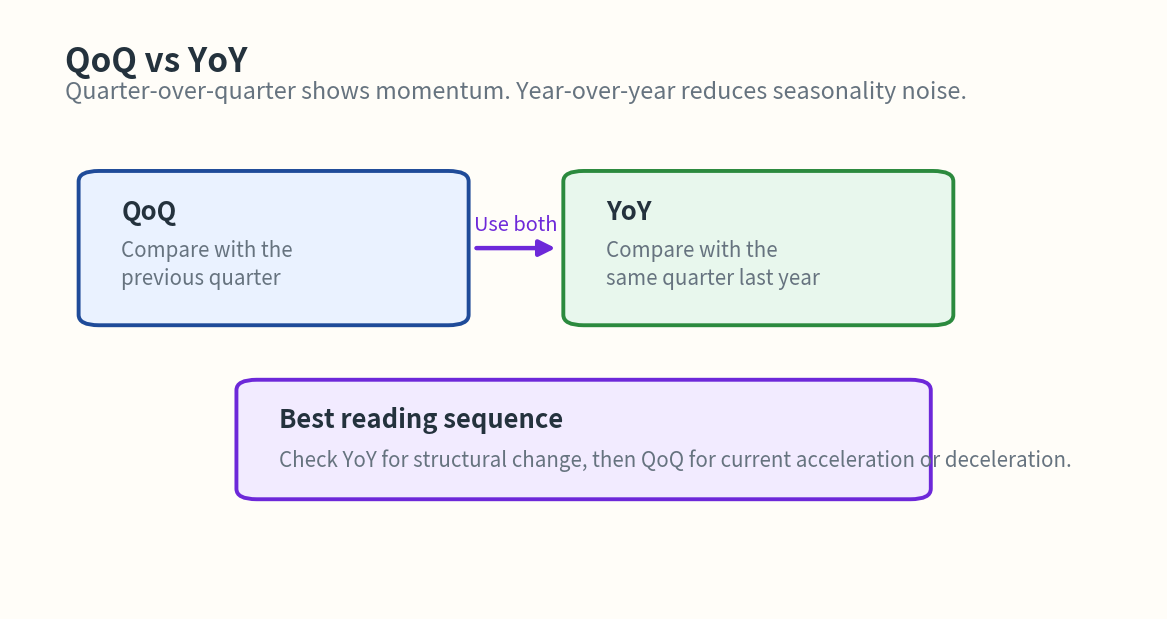
QoQ helps with short-term turning points. YoY helps with cleaner structural comparisons.
Practical reading framework
Use this table:
| Comparison | Best used for | Main question |
|---|---|---|
| QoQ | Short-term turns | Is the business improving right now? |
| YoY | Structural comparison | Is this quarter better than a comparable prior period? |
| Both | Higher-confidence reading | Is the improvement real in both time frames? |
If QoQ improves sharply but YoY still looks weak, the company may be in an early recovery stage. If YoY is strong but QoQ slows, the business may still be good but momentum may be cooling.
How the market reacts
Markets often react differently depending on context.
- Low-expectation turnarounds: QoQ can matter more
- Seasonal industries: YoY often matters more
- High-expectation stocks: the market may need both to stay strong
That is why a single strong comparison line is not always enough. The stock may need confirmation from the other axis too.
Investor checklist
- Is the industry seasonal enough that YoY should carry more weight?
- Is the company near a turn where QoQ matters more?
- Do QoQ and YoY point in the same direction?
- If they differ, which one better matches the current investment question?
- Did the stock react to short-term acceleration or to longer-term structure?
Common mistakes
- Treating QoQ and YoY as interchangeable
- Ignoring seasonality
- Treating one strong line as enough proof
- Using QoQ alone in highly seasonal businesses
- Using YoY alone when a recent turn is the main story
Summary
QoQ and YoY answer different questions. QoQ is stronger for short-term turns. YoY is stronger for cleaner comparisons across seasonal patterns. Investors usually make better decisions when they decide which question matters first, then read both.