Introduction
Annual reports are essential for business analysis, but they feel overwhelming when you first open them. The practical solution is not to read every page in order. It is to decide what matters first.
The point of an annual report is not to admire the company description. It is to find out how the company makes money, what can hurt it, and where management is actually allocating capital.
Why business structure matters
You read an annual report to confirm structure, not to repeat management language. Most companies can sound impressive in a summary. The annual report matters because it forces the business model, risks, and capital plan into a formal document.
For investors, the best use of the report is simple. First, understand where the business earns money. Second, locate the gap between the positive story and the actual risks.
Core framework
The most practical way to read an annual report is in three blocks.
First, read the business description and revenue structure. You need to know what the company sells, who the customers are, which segments matter, and whether revenue is recurring or one-off.
Second, read the risk factors and competitive environment. Customer concentration, raw material sensitivity, regulation, technology shifts, and cycle exposure often matter more than the polished introduction.
Third, read capital allocation. Facilities, R&D, subsidiaries, and investment plans tell you what the company is actually trying to build.
Visual guide
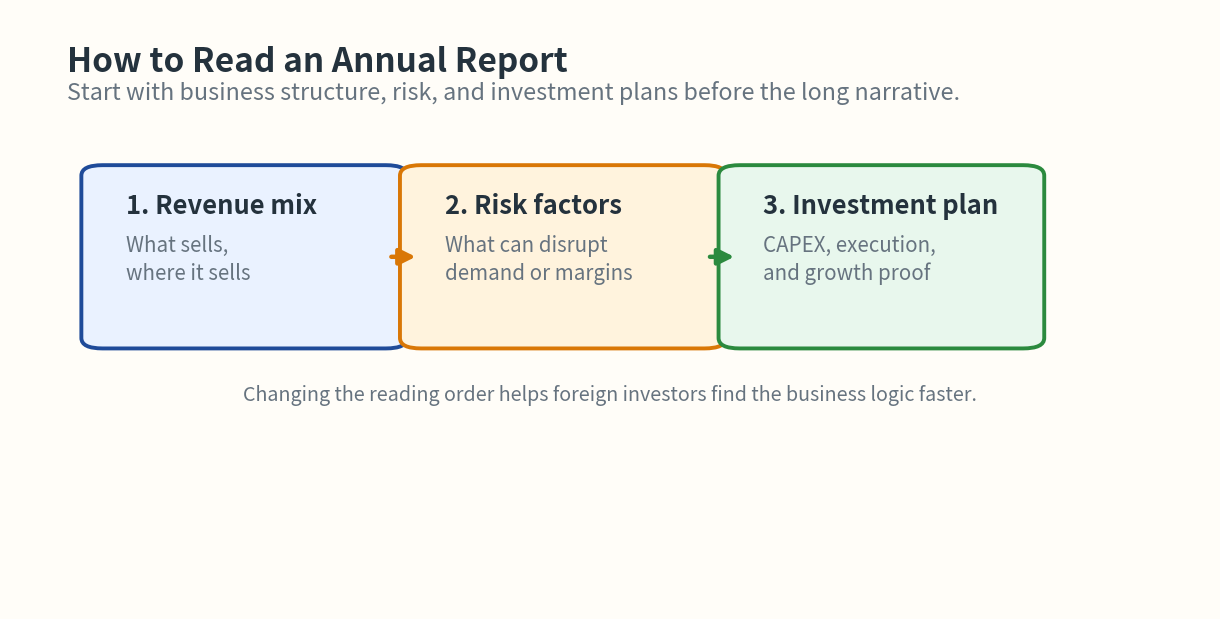
The annual report becomes more useful when you read business model, risks, and investment plans before you read the story as a whole.
Where to verify it
These sections matter most:
Business description: what the company actually sells and where demand comes fromProducts and revenue breakdown: segment mix, customer exposure, geographyRisk factors: pricing pressure, regulation, raw material costs, customer concentrationFacilities and R&D: growth plans, expansion logic, capital allocationFinancial statements and cash flow: whether the story is showing up in numbers
Recent disclosures matter too. The annual report shows the structural picture, while newer disclosures show whether that structure is still improving or starting to weaken.
What to check in a company
Start with these five questions:
- What does the company actually sell?
- Which business lines are core and which are secondary?
- What can disrupt the business most?
- Where is management spending money now?
- How could that spending turn into future revenue and profit?
Investor checklist
- Did you identify the main products and customer groups before reading the whole story?
- Did you separate the largest revenue line from the most important profit engine?
- Did you mark real risk factors instead of skipping them as boilerplate?
- Did you connect CAPEX and investment plans to the company’s growth story?
- Did you verify whether the narrative is actually visible in financials and cash flow?
Typical misunderstandings
- A report must be read linearly from first page to last page.
- Reading the company overview is almost enough.
- Risk factors are just formal disclosures with no practical use.
Example scenario
Take an equipment maker as an example. Start by identifying what kinds of equipment it sells and which industries it serves. Then move to segment revenue to see whether it depends heavily on one customer group or one industry. After that, read the risk section for customer capex cycles, cost pressure, and technology transition risk. Finally, read the facility and R&D sections to see whether management is actually preparing for the next demand wave.
That sequence turns the report from a long document into a map of the business.
Common mistakes
- Spending too much time on company introduction pages
- Jumping to price action or news before understanding revenue structure
- Ignoring risk factors and investment plans, then overstating the growth story
Summary
The annual report becomes useful when you know what to read first. The best practical order is business description and revenue structure, risk factors, investment plans, and then financial confirmation.
Once that order is clear, the report stops being a pile of pages and starts becoming a business map.