Introduction
CPI days often create large market swings because inflation data can change the expected policy path, bond yields, the dollar, and equity leadership at the same time.
That is why CPI is rarely just an inflation headline. It is usually a repricing event across several assets at once.
One-line summary
CPI matters because it can shift rate expectations, bond yields, the dollar, and equity style leadership in one release.
Key terms first
Headline CPI: the broad inflation reading including food and energy.Core CPI: inflation excluding food and energy.Inflation surprise: the gap between actual CPI and what the market expected.
The important question is often not whether CPI is high or low in isolation, but whether it was hotter or cooler than expected.
Why this macro variable matters
Inflation affects how central banks think about rates. That makes CPI one of the clearest bridges between economic data and market pricing.
When CPI surprises higher:
- short-term yields often rise
- the dollar may strengthen
- high-multiple growth stocks may come under pressure
When CPI surprises lower, the reverse can happen.
How it connects to stocks
Markets often react in layers:
- actual CPI versus expected CPI
- 2-year yield and dollar reaction
- growth versus value or cyclical leadership
- whether the move holds into the close
That is why CPI interpretation improves when investors watch bonds and style rotation together.
Visual guide
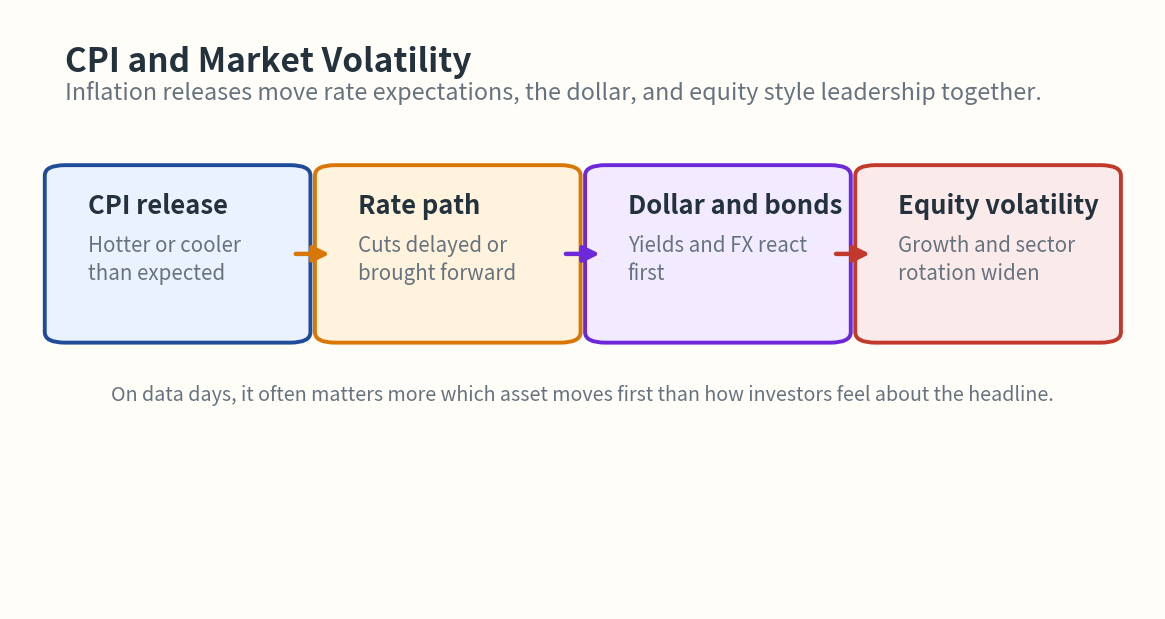
On CPI days, inflation data often changes several market prices at once.
Real data example
The effect is easier to understand when you line up real releases.
| Real case | Reported number | What the market focused on |
|---|---|---|
| U.S. CPI, June 2022 | 9.1% YoY |
Fear that the Fed would need to stay aggressive for longer |
| U.S. CPI, June 2024 | 3.0% YoY, core 3.3% |
Renewed hope that the rate-cut window was getting closer |
The contrast matters. In mid-2022 the market mainly asked, How much more tightening is coming? By mid-2024 the better question became, How soon can easing begin? The data category stayed the same, but the macro regime changed.
How investors can use it
The practical sequence is simple:
- Write down the actual CPI number and the consensus.
- Check core CPI so you know whether the surprise was broad or narrow.
- Watch the 2-year Treasury yield and the dollar first.
- Then compare Nasdaq, financials, and small caps into the close.
For investors watching Korean equities, the bridge is often U.S. CPI -> U.S. 2-year yield -> Dollar Index and USD/KRW -> KOSPI and KOSDAQ style leadership. USD/KRW is the Korean won price of one U.S. dollar. KOSPI is South Korea’s main large-cap benchmark, while KOSDAQ is its more growth- and small-cap-heavy market.
Practical framework
Use this order:
- Compare actual CPI to expectations
- Check core CPI too
- Watch the 2-year yield and the dollar
- Check Nasdaq, financials, and small caps
- See whether the reaction survives into the close
What to watch together
- CPI becomes more useful when it is read together with
core inflation, wage data, and producer-price data. - The
2-year U.S. Treasury yieldoften reveals the policy interpretation faster than equities do. - For readers watching Korean equities, the practical bridge is often
U.S. CPI -> 2-year yield -> dollar -> KOSPI / KOSDAQ tone.KOSPIis South Korea’s main large-cap index, whileKOSDAQis its more growth- and small-cap-heavy market.
Investor checklist
- Was CPI above or below expectations?
- Did core CPI tell the same story?
- Did the 2-year yield confirm the interpretation?
- Did the dollar strengthen or weaken?
- Which equity style reacted the most?
Common mistakes
- Watching only the headline number
- Ignoring expectations
- Skipping the bond-market reaction
- Reading the opening move as the full answer
Summary
CPI moves markets because it changes the expected rate path, not just the inflation narrative. The most reliable sequence is inflation surprise -> bonds and dollar -> equity style reaction -> closing confirmation.