Introduction
Exchange rates do not affect every company the same way. A weaker local currency can help exporters while hurting importers, but the real effect depends on pricing power, input costs, and how quickly those changes flow through.
That is why currency moves should be read through business structure, not through a simple weak currency good shortcut.
One-line summary
FX moves matter differently for exporters and importers because revenue, costs, and pricing power react on different timelines.
Key terms first
Exporter: a company that sells more abroad and receives foreign-currency revenue.Importer: a company that depends more on foreign inputs or foreign-currency purchases.Pass-through: how much of a currency move gets reflected in prices or margins.
Why this macro variable matters
FX changes can affect:
- reported revenue translation
- input costs
- export competitiveness
- inventory and margin timing
That means the same currency move can help one sector and hurt another.
How it connects to stocks
A weaker local currency often helps exporters when:
- foreign sales are meaningful
- pricing remains intact
- imported input costs are manageable
It often hurts importers when:
- raw materials or finished goods are dollar-priced
- pricing power is weak
- margins are already tight
Visual guide
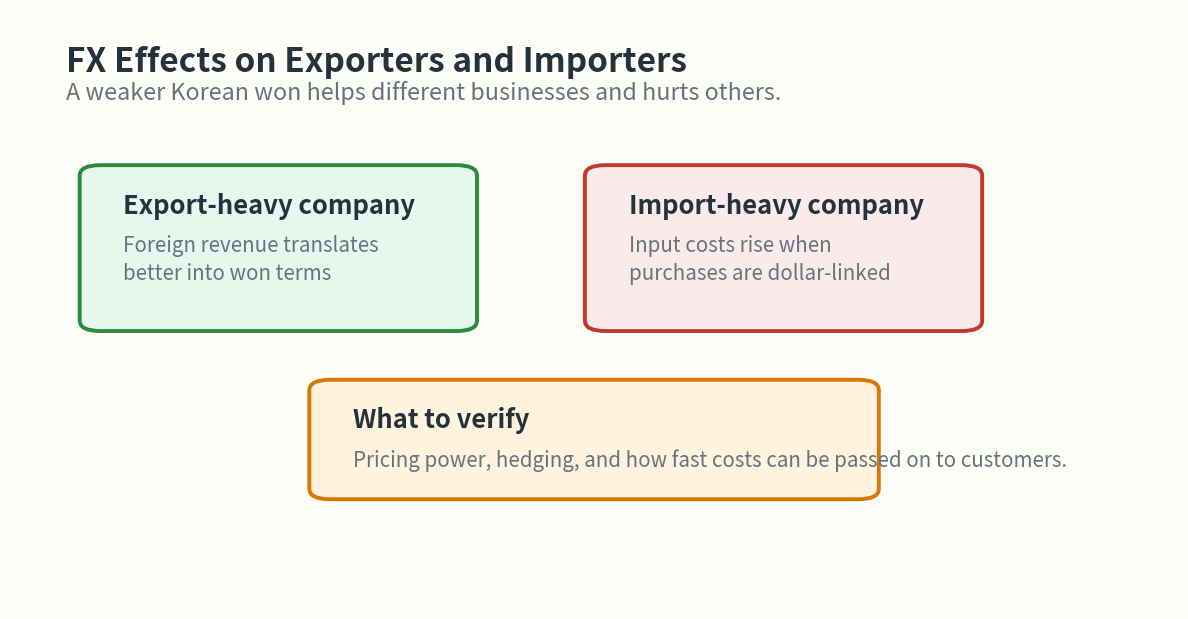
FX is not only a currency story. It is also a margin and pricing-power story.
Real data example
The 2022 strong-dollar phase is the cleanest real-world example. When USD/KRW moved above 1,400, the Korean market did not treat every stock the same way.
| What investors watched during the 2022 won-weakness phase | What the market actually cared about | Practical lesson |
|---|---|---|
| Exporters such as semiconductors and autos | Translation benefit on dollar revenue | FX help can still be offset if global demand is weakening |
| Airlines and travel | Higher fuel, lease, and dollar-settlement burden | FX and oil should be read together |
| Food and retail importers | Higher imported input costs | The key question is whether costs can be passed through |
For an overseas reader, USD/KRW simply means the Korean won price of one U.S. dollar. A higher number means a weaker won. Even in the same market, a weaker won can be a tailwind for one business model and a margin squeeze for another.
How investors can use it
Read FX through the income statement.
- Check whether revenue is mostly earned in foreign currency or costs are paid in it.
- Separate translation benefit from real margin improvement.
- Ask whether the company can pass higher imported costs through.
- Compare peers, because the market usually rewards the cleaner business model first.
In Korean equities, a weaker won can help exporters listed in the KOSPI, South Korea’s main large-cap market, while import-heavy or travel-sensitive names can lag. The same currency move can create opposite stock reactions inside the same country.
Practical framework
Use this order:
- Identify whether the company is exporter-heavy or importer-heavy
- Check how much of revenue or cost is FX-sensitive
- Ask whether pricing power allows pass-through
- Check whether the stock is reacting to translation, margin, or competitiveness
What to watch together
- Read
USD/KRWtogether with theDollar Indexso you can tell whether the move is Korea-specific or part of a broader global dollar surge. - For Korean equities, check whether the move is helping
KOSPIexporters while hurting more domestic or import-sensitive names.KOSPIis the main Korean large-cap benchmark. - FX should also be read with commodity prices. A weaker won plus higher oil is very different from a weaker won with softer input costs.
Investor checklist
- Does the company earn more in foreign currency or spend more in it?
- Can it pass higher costs through to customers?
- Are the FX effects immediate or delayed?
- Is the market focusing on revenue translation or on margin pressure?
- Are peers reacting the same way?
Common mistakes
- Assuming weaker currency helps all exporters equally
- Ignoring imported input costs
- Treating FX translation and true business improvement as the same thing
- Forgetting that FX effects can arrive with a lag
Summary
Currency moves affect exporters and importers differently because revenue, costs, and pricing power do not adjust at the same speed. The useful sequence is business model -> FX exposure -> pass-through power -> margin effect -> stock reaction.