Introduction
Two of the most overlooked ETF ideas are tracking error and premium/discount. Investors often buy an ETF for market exposure, but the real product may not match the underlying benchmark perfectly at every moment.
That gap matters more when markets are volatile, liquidity is weak, or structure is more complex.
One-line summary
Tracking error and premium/discount matter because an ETF can deviate from its benchmark or its underlying value in ways that affect returns and execution.
Core framework
The simplest split is:
- tracking error: the ETF’s performance gap versus its benchmark over time
- premium/discount: the gap between ETF market price and net asset value at a point in time
One is about return quality over time. The other is about trading quality right now.
How it connects to investing
These ideas matter when:
- comparing similar ETFs
- trading in volatile conditions
- evaluating specialized, thinly traded, or international funds
Ignoring them can lead investors to think they own one exposure while receiving another.
Visual guide
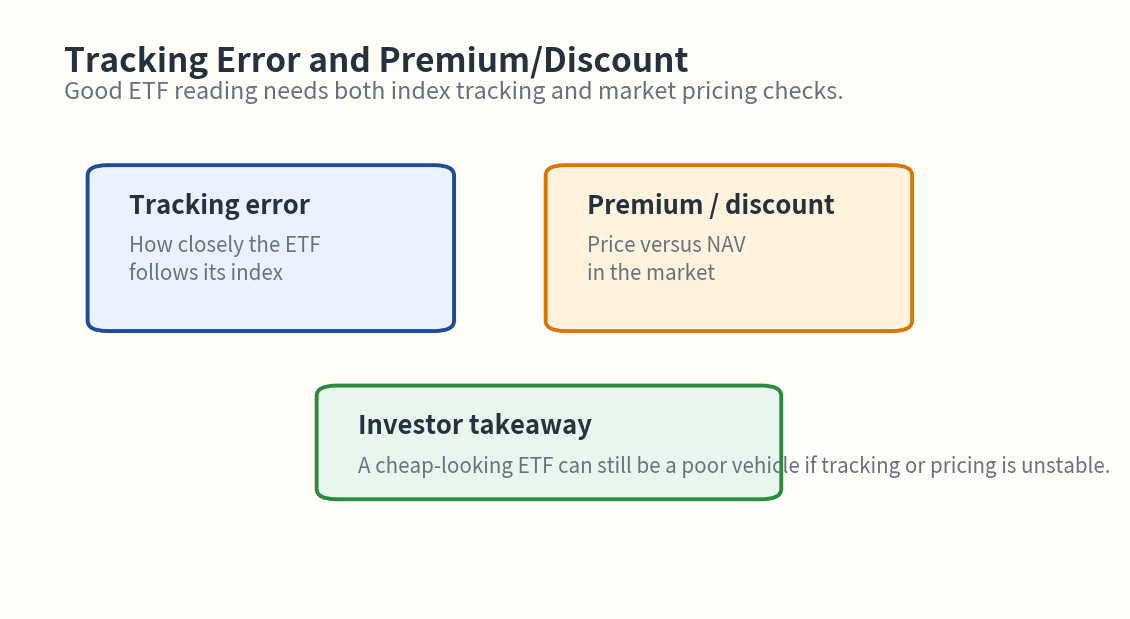
An ETF can differ from both its benchmark over time and its NAV at the moment of trade.
Practical framework
Use this order:
- Check the benchmark and holdings method
- Check tracking consistency
- Check the premium or discount at execution
- Compare with similar ETFs if multiple choices exist
Investor checklist
- How closely does the ETF track its benchmark over time?
- Is the current premium or discount unusually wide?
- Is liquidity good enough for the trade size?
- Is this ETF more exposed to tracking issues than a simpler peer?
Common mistakes
- Ignoring premium or discount when entering a trade
- Treating all tracking gaps as temporary noise
- Comparing ETFs only by headline theme or index name
- Assuming price always equals clean underlying value
Summary
Tracking error and premium/discount matter because ETFs are tradable products, not pure mathematical exposures. Investors should care about both long-term tracking quality and point-in-time execution quality.