Introduction
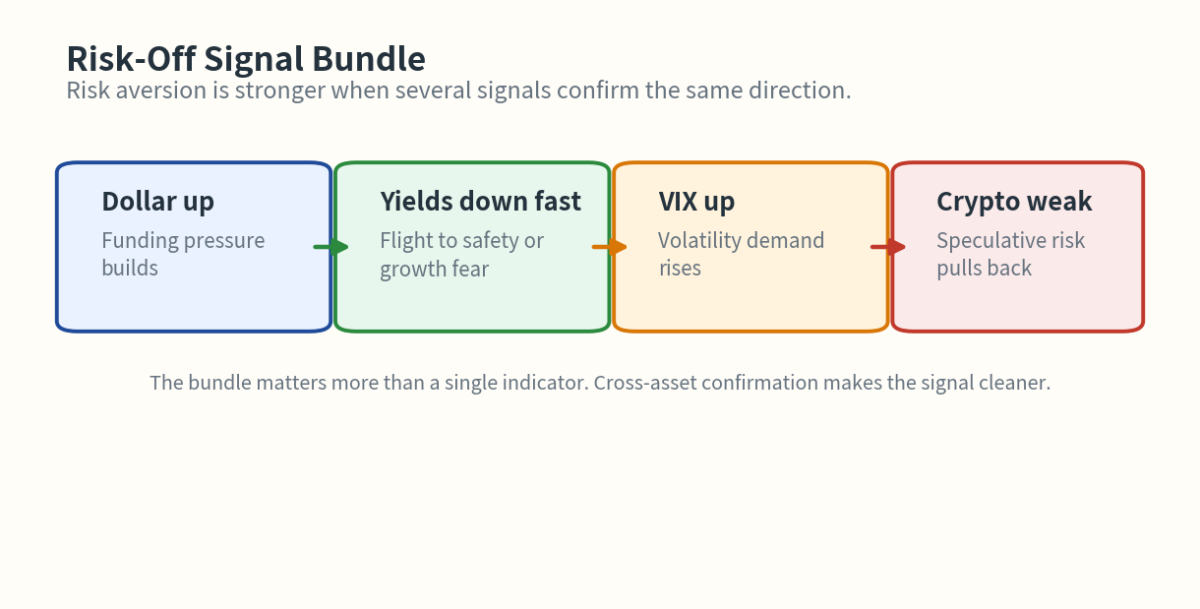
Risk-off periods are rarely defined by one signal alone. They usually appear as a bundle: stronger dollar, lower cyclicals, wider credit stress, weaker high-beta equities, and more defensive leadership.
That is why investors should avoid reading risk-off through only one chart.
One-line summary
Risk-off is best read through a bundle of signals, not through a single asset move.
Core framework
The most useful bundle often includes:
- stronger dollar
- rising short-end yield pressure or tightening conditions
- weaker high-beta equities
- stronger defensives
- lower appetite for cyclical or speculative exposure
No one signal is enough by itself. The combination matters.
How it connects to stocks
Risk-off often shows up as:
- growth and cyclicals losing leadership
- defensives or cash-like positioning improving
- weaker breadth
- weaker lower-quality balance sheets
That is why relative strength inside equities matters so much.
Visual guide
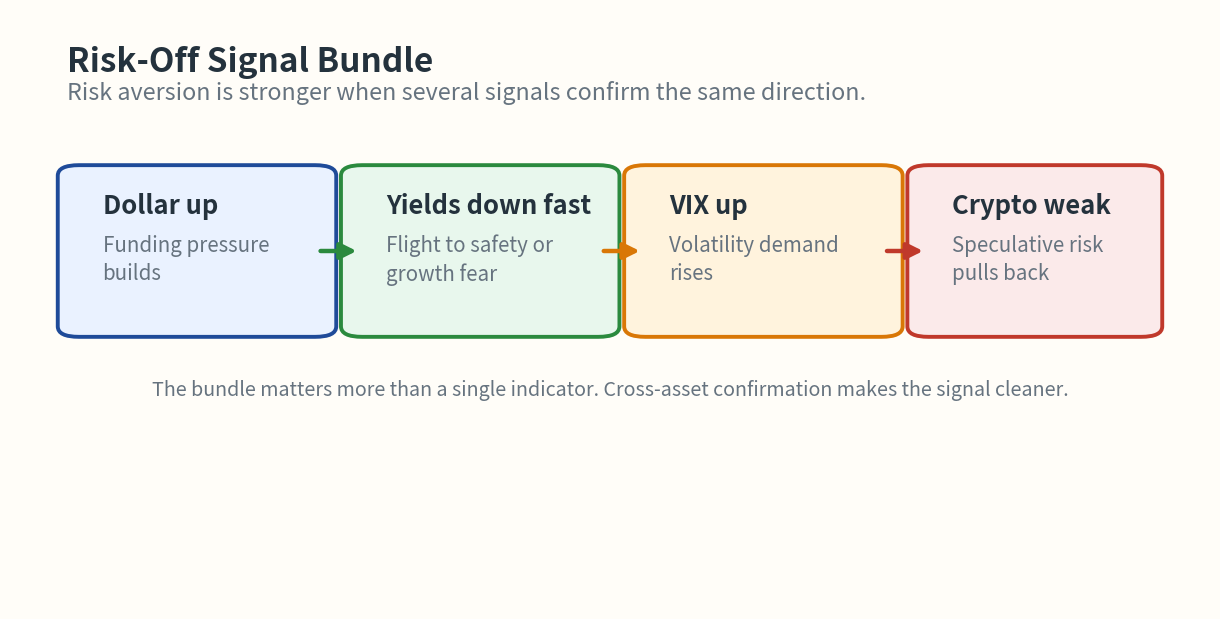
Risk-off regimes usually become clearer when several signals line up together.
Real data example
The bundle worked differently in two recent regimes.
| Real case | Signals moving together | Practical read |
|---|---|---|
| 2022 inflation-shock regime | Stronger dollar, weaker growth stocks, higher volatility, pressure on Bitcoin | Tightening-driven risk-off |
| March 2023 regional-bank stress | Bank weakness, wider credit stress, lower long yields, stronger demand for safety | Financial-stress risk-off |
Gold and oil did not send the same message in both cases. That is exactly why a bundle beats a single indicator.
Practical framework
Use this order:
- Check the dollar and yields
- Check equity breadth and high-beta weakness
- Check defensives versus cyclicals
- Ask whether the move is spreading or still isolated
How investors can use it
Use a bundle instead of a single fear gauge.
- Do not call
risk offfrom an index down day alone. - Check whether the dollar, volatility, and credit-sensitive assets agree.
- Add gold, oil, and Bitcoin to understand the type of stress.
- Watch whether defensives and low-beta stocks keep outperforming.
The bundle helps distinguish inflation-fear selloffs from growth-slowdown or financial-stress episodes.
What to watch together
- Dollar strength, higher volatility, and weaker Bitcoin usually make the risk-off read cleaner.
- Falling yields are not always bullish; they can reflect growth fear or a flight to safety.
- Gold can rise because of safety demand or because yields fall, so it needs context.
- Oil does not always fall in risk-off periods because supply shocks can still keep it elevated.
Investor checklist
- Is the dollar strengthening?
- Are high-beta groups under pressure?
- Are defensives outperforming?
- Is breadth weakening?
- Are multiple risk-off signals aligning at once?
Common mistakes
- Treating one red day as a full risk-off regime
- Ignoring breadth and relative strength
- Watching the index only
- Failing to distinguish isolated weakness from broad defensive rotation
Summary
Risk-off is more reliable when several signals confirm it together. The best sequence is dollar and yields -> breadth -> defensives versus cyclicals -> spread of weakness.