Introduction
Broad-market ETFs and sector ETFs can both look simple, but they do very different jobs in a portfolio. One is usually about general market participation. The other is often about concentration, rotation, or a stronger macro or thematic view.
One-line summary
Broad-market ETFs aim for market participation, while sector ETFs offer concentrated exposure and stronger relative bets.
Core framework
The practical split is:
- broad-market ETF: diversified market exposure
- sector ETF: concentrated exposure to one part of the market
That means sector ETFs can outperform faster, but they can also be much more sensitive to cycle, sentiment, and rotation.
How it connects to investing
Broad-market ETFs are usually better for:
- core exposure
- long-term simplicity
- lower concentration risk
Sector ETFs are more useful for:
- tactical views
- relative-strength ideas
- specific macro or industry convictions
Visual guide
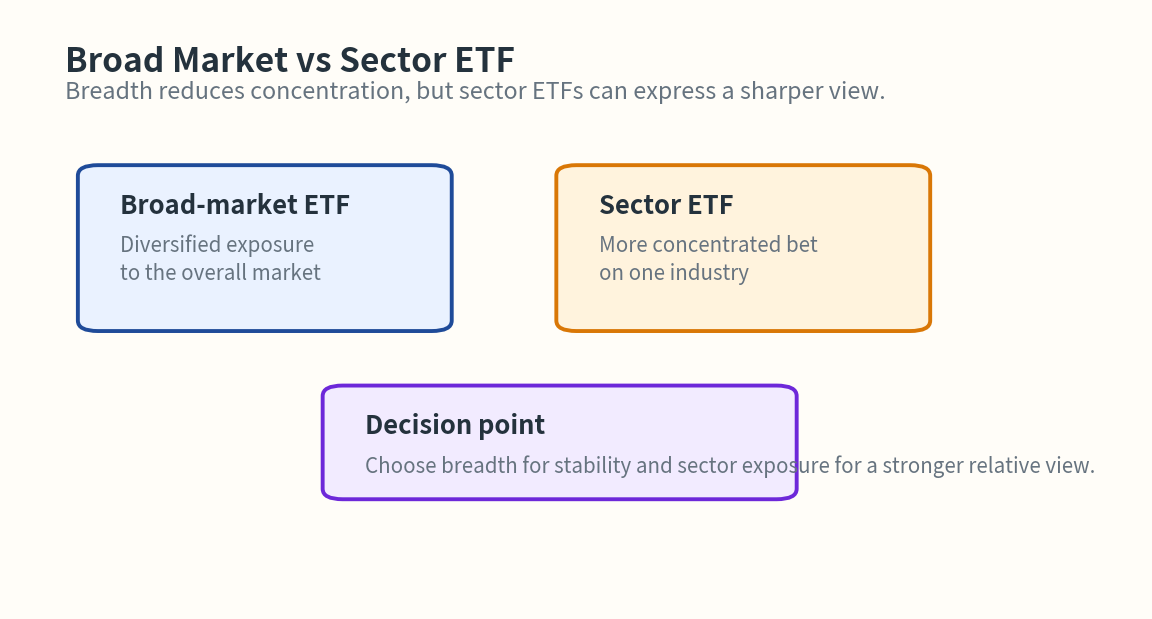
Sector ETFs usually trade away diversification in exchange for sharper exposure.
Practical framework
Use this order:
- Decide whether the role is core exposure or tactical exposure
- Check concentration level
- Check how sensitive the ETF is to macro, style, or sector rotation
Investor checklist
- Is this ETF meant to be core or tactical?
- How concentrated is the exposure?
- What macro or earnings drivers matter most?
- Are you prepared for stronger swings than in a broad-market ETF?
Common mistakes
- Treating sector ETFs as if they were broad diversification tools
- Using a tactical ETF as a core holding without adjusting expectations
- Ignoring concentration risk
- Failing to connect sector ETFs with the macro or business cycle
Summary
Broad-market ETFs and sector ETFs solve different problems. The clean way to think about them is core participation versus concentrated expression.