Introduction
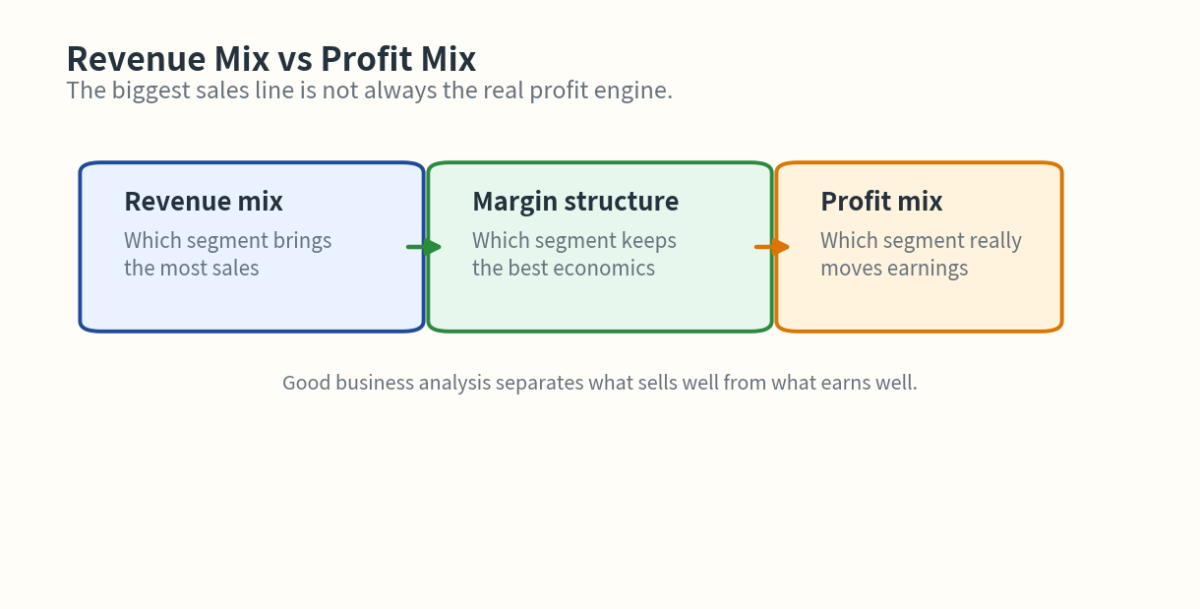
When people describe a company, they usually start with revenue share. But in investing, the more important question is often not which business sells the most. It is which business earns the most.
That is why revenue mix and profit mix should be read separately. If they diverge, the same top-line growth can mean very different things.
Why business structure matters
One of the most common mistakes in business analysis is assuming the biggest revenue segment must also be the core business. In reality, low-margin segments can dominate revenue while smaller, higher-margin segments generate most of the economic value.
If you miss that distinction, it becomes easy to overrate size and underrate mix improvement. Markets often react more strongly to product mix change than to simple sales growth for exactly this reason.
Core framework
The first question is where revenue comes from. Segment, product, customer, and regional mix tell you where the company’s size is built.
The second question is where profit comes from. Even when segment operating profit is not fully disclosed, you can often infer the higher-value business by looking at pricing power, technical difficulty, switching costs, recurring revenue, and management emphasis.
The third question is which direction the mix is moving. If low-margin businesses are driving size while high-margin businesses are expanding too slowly, the structure may be weaker than the headline growth suggests. If higher-value businesses are gaining weight, interpretation can improve even with only moderate top-line growth.
Visual guide
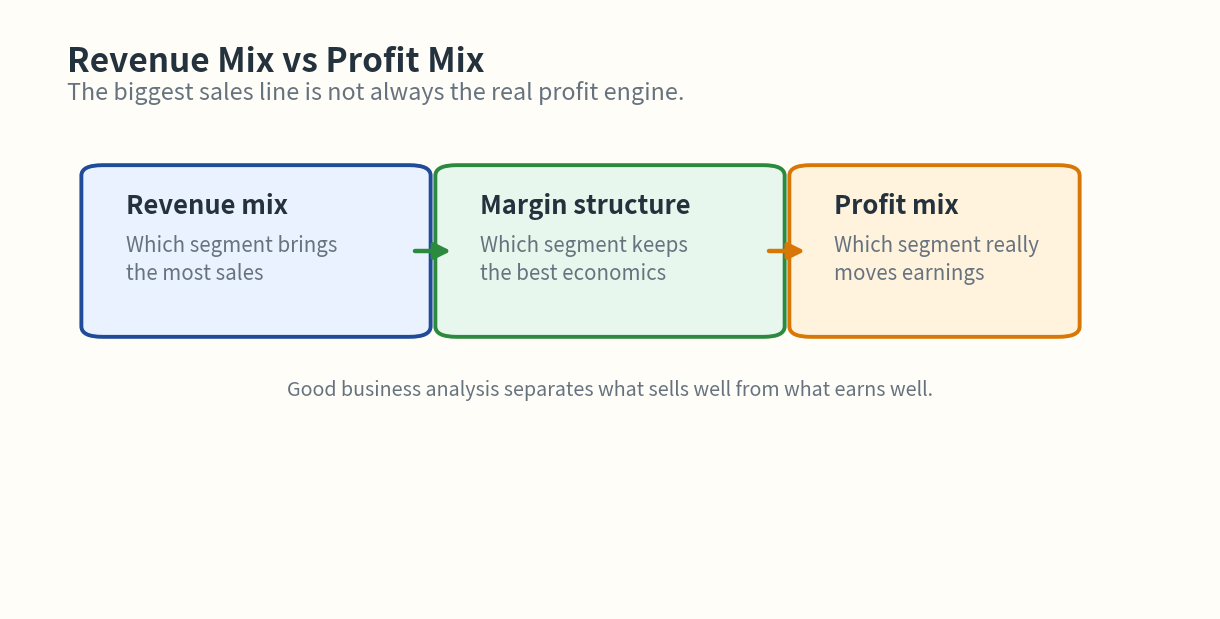
The largest revenue segment is not always the segment creating the most profit or strategic value.
Where to verify it
The most practical order is:
- In the annual report, check business description, key products, and segment revenue breakdown.
- In financials and earnings commentary, check operating margin, product mix change, and references to premium products.
- In recent disclosures, check contracts, new customers, expansion plans, and product launches tied to specific segments.
- In market reaction, check whether investors reacted more to structural improvement than to raw revenue growth.
When segment profit is not explicitly disclosed, the next best approach is to ask which business has stronger pricing power, better customer lock-in, better gross economics, and more visible investment support.
What to check in a company
Use this sequence:
- How is segment revenue split?
- Which business likely carries higher margin and stronger competitive advantage?
- Which direction is mix moving in recent periods?
- Is higher-margin expansion visible through capex, customers, or disclosures?
- Is the market reacting to structure improvement rather than only to bigger revenue?
Investor checklist
- Did you avoid treating revenue share and profit contribution as the same thing?
- Did you verify the basis for the higher-margin business in filings or disclosures?
- Is mix change actually showing up in operating margin improvement?
- Did you avoid overstating low-margin scale expansion as structural improvement?
- Did you check which business changes the market seems to care about most?
Typical misunderstandings
- The biggest segment by sales must be the most important business.
- A smaller high-margin business cannot matter much yet.
- Total revenue growth matters more than mix change.
Example scenario
Imagine an electronic components company. Commodity parts contribute most of revenue, but specialty materials and high-spec components generate most of the profit. In that case, the real strategic question is not whether commodity sales are growing faster. It is whether premium products are gaining customers, capacity, and mix share.
If total revenue grows only modestly but overall margin improves and new investment keeps supporting higher-value products, the market may read that as structural improvement. If low-margin segments expand aggressively and margins weaken, the interpretation can turn more cautious even with strong top-line growth.
The practical split is:
- Facts: segment revenue, mix change, margin change, relevant disclosures
- Interpretation: which business is truly carrying the company and which shift deserves a premium
Common mistakes
- Following the largest segment and calling it the core business by default
- Repeating premium-product language without checking real proof
- Ignoring the connection between mix change, margin, cash flow, and capex
- Blending business structure and stock interpretation into one overly simple conclusion
Summary
The real strength of a business often depends less on how much it sells and more on where it actually earns. That is why revenue mix and profit mix should be separated.
The best sequence is revenue split -> margin structure -> mix change -> supporting disclosures and investment -> market reaction.